How does Feng Shui work, and can the way you use your home really make a difference to your life?
Most people discover Feng Shui through advice about furniture placement, lucky colours, money plants or decorating a particular corner of their home to attract prosperity.
But there’s something far more fascinating behind this ancient Chinese practice.
Classical Feng Shui is a traditional system that examines the relationship between your home, its surrounding environment, its compass orientation and the movement of Qi.
Rather than treating every home the same, it uses established principles and mathematical calculations to assess the individual characteristics of a property.
And that’s where Feng Shui becomes much more interesting than simply deciding where to place your sofa.
In this guide, you’ll discover how Feng Shui works, the principles behind Classical Feng Shui, why your home’s Flying Stars matter and how to begin understanding the Feng Shui of your own property.
What Is Feng Shui and How Does It Work?
Feng Shui is an ancient Chinese practice based on understanding the relationship between people and their environment.
The words Feng Shui translate to wind and water, reflecting the traditional understanding of how Qi moves, gathers and disperses through the landscape.
Qi is a central concept in Chinese philosophy and Feng Shui. Within this traditional system, it describes the vital influence believed to flow through and interact with our surroundings.
Classical Feng Shui practitioners examine both the visible and calculated characteristics of a property to understand how it is traditionally assessed.
These include:
- The surrounding landscape and neighbouring buildings
- The shape and layout of the property
- The location of entrances, bedrooms and living spaces
- The home’s precise compass orientation
- The property’s construction period
- The distribution of its Flying Stars
- The relationships between the Five Elements
Together, these factors form the basis of a Classical Feng Shui analysis.
The most important thing to understand is that every property has its own Feng Shui characteristics.
Two homes can look almost identical yet have different Flying Stars charts, different environmental conditions and different recommendations.
That’s why generic advice doesn’t always translate into an accurate assessment of your home.
How Does Feng Shui Work in a House?
To understand how Feng Shui works in a house, imagine that your home has two different layers.
The first is everything you can physically see.
Your front door, bedrooms, windows, hallways, surrounding buildings, pathways and outdoor spaces.
The second is the traditional energetic blueprint calculated through Classical Feng Shui methods.
This blueprint is developed using compass measurements, the property’s relevant construction period and established mathematical formulas.
In Flying Stars Feng Shui, the resulting chart identifies nine symbolic stars distributed throughout the property.
Each star has particular associations within the system, and their combinations are interpreted according to their positions and relationships.
The process generally follows five stages.
1. Examine the surrounding environment.
The practitioner considers the landscape, neighbouring structures, roads, entrances and other physical features.
2. Determine the property’s orientation.
Accurate compass measurements establish the directional information needed for further calculations.
3. Construct the Flying Stars chart.
The home’s relevant construction period and orientation are used to calculate its natal chart.
Want to discover your home’s Flying Stars?
Learn how to create your home’s unique Flying Stars chart in my FREE mini course. It’s your first step towards understanding the Classical Feng Shui of your own home.
4. Map the chart onto the floor plan.
The practitioner identifies where the calculated stars fall throughout the property.
5. Interpret the results.
The Flying Stars, physical environment and use of each space are assessed together before recommendations are made.
This is how Classical Feng Shui moves from traditional theory into the practical assessment of a home.
The Three Foundations of Classical Feng Shui
Although Feng Shui contains several traditional schools and methods, three important areas help explain how a Classical assessment works.
1. Form School Feng Shui: Understanding Your Surroundings
Form School Feng Shui examines the physical environment.
This includes the land surrounding a property, nearby buildings, roads, pathways, entrances and the shape of the home itself.
Within traditional Feng Shui, these features are assessed for how they influence the movement and collection of Qi.
For example, the approach to your front door is considered important because entrances are traditionally associated with the way Qi enters a property.
The positioning of surrounding buildings and the relationship between indoor and outdoor spaces also form part of the assessment.
Form School is particularly important because a property’s physical environment provides the setting in which its other Feng Shui characteristics are interpreted.
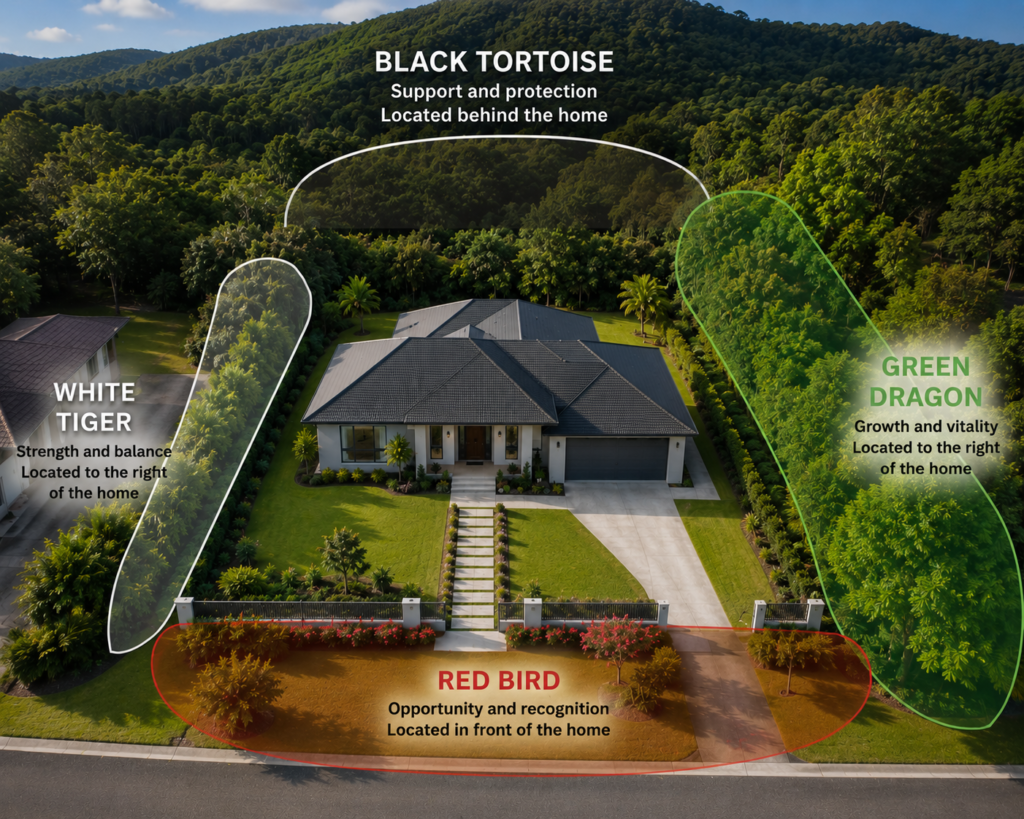
See how the landscape holds and supports this home? This is the ideal Form School setup. The Green Dragon represents growth and motivation to get out there and make something of yourself. The Black Tortoise brings support, backing and authority, while the open space of the Red Bird welcomes opportunity and recognition. The White Tiger balances the Dragon, bringing yin and yang into harmony. Together, these formations support a home where you feel grounded, motivated and ready to move forward.
2. Compass School Feng Shui: Why Direction Matters
Compass School introduces directional principles and calculations.
Accurate compass measurements are used to determine a property’s orientation and identify its directional sectors.
But here’s something many beginners don’t realise.
Knowing which direction a room occupies doesn’t automatically tell you whether that room has favourable Feng Shui.
For example, the southeast is traditionally associated with wealth within the Eight Trigrams system.
However, this does not mean that the southeast corner of every home contains its strongest Flying Stars prosperity influence.
That requires further analysis.
A compass direction provides important information, but it is not the complete picture.
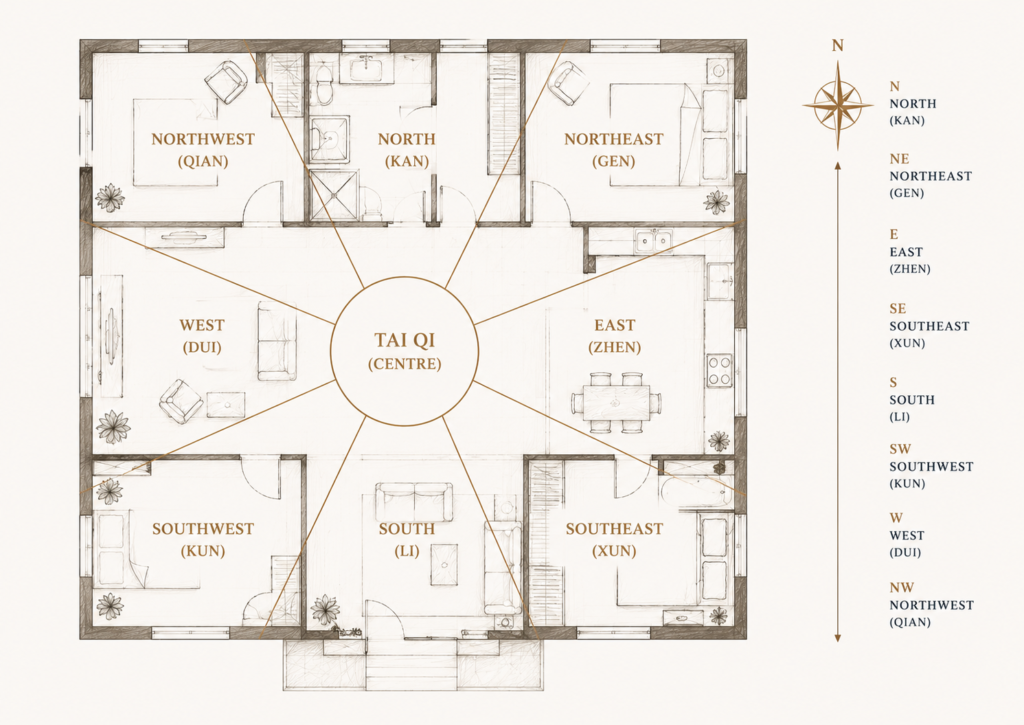
See how the lines divide this floor plan into different sections? These mark the compass sectors used to locate your home’s energetic fields. They don’t stop at walls or doorways, so one room might contain more than one. Mapping them accurately shows you exactly where each field falls, so you know where to make changes and how to work with the Feng Shui of your home.
3. Flying Stars Feng Shui: Your Home’s Individual Blueprint
Flying Stars Feng Shui is one of the most detailed calculation systems used in Classical Feng Shui.
It examines nine symbolic stars and their distribution throughout a property.
A natal Flying Stars chart is constructed using the home’s relevant period and precise directional orientation.
The resulting chart contains star combinations across nine sectors.
These combinations are then interpreted according to traditional principles.
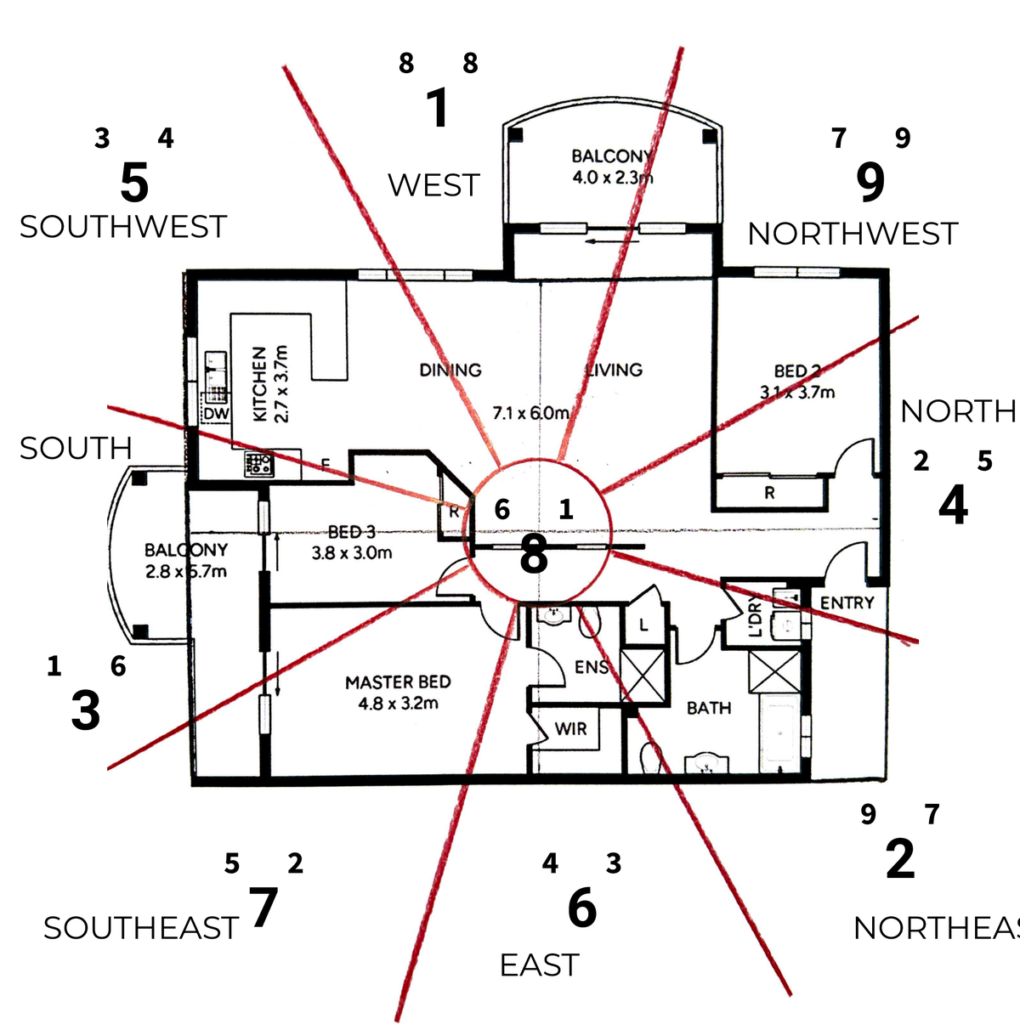
See how each section now has its own Flying Stars combination? This is where we get into advanced Feng Shui. These combinations reveal the character of each space and its traditional influences on prosperity, health and relationships. Where you spend your time matters, especially where you sleep and work. Mapping your Flying Stars shows you which areas to make greater use of, which need remedies and where a simple change of position brings you into a more supportive field.
Two particularly important stars are:
The Health Star
Traditionally associated with health, relationships, support and personal wellbeing.
The Wealth Star
Traditionally associated with prosperity, opportunities and financial activity.
Their influence is interpreted in relation to the other stars, the property’s physical features and how each area is used.
This is why an accurate Flying Stars chart is so important.
Without it, you’re missing a significant part of the information used in Classical Feng Shui analysis.
Your chart is just the beginning. The real power is understanding what your Flying Stars reveal and how to work with them in your home. Explore this further in Flying Stars Feng Shui: The Powerful Secret Most People Miss.
How Do the Five Elements Work in Feng Shui?
The Five Elements are another essential part of traditional Feng Shui.
They are:
- Wood
- Fire
- Earth
- Metal
- Water
Each element represents particular qualities and relationships within Chinese metaphysical theory.
Rather than operating independently, the elements interact through traditional cycles.
The Productive Cycle
The productive cycle describes how one element supports another.
- Wood feeds Fire.
- Fire produces Earth.
- Earth produces Metal.
- Metal supports Water.
- Water nourishes Wood.
The Controlling Cycle
The controlling cycle describes how the elements regulate one another.
- Wood controls Earth.
- Earth controls Water.
- Water controls Fire.
- Fire controls Metal.
- Metal controls Wood.
These relationships are important when interpreting Flying Stars and considering traditional elemental remedies.
For example, a practitioner may assess whether a particular elemental quality is appropriate for a specific star combination.
However, this does not mean every room should contain all five elements.
Nor does it mean a particular colour is automatically beneficial simply because it belongs to a certain element.
In Classical Feng Shui, the appropriate elemental response depends on what is actually present within the property’s chart.
That’s why accurate calculations come before decorative decisions.
How Does Flying Stars Feng Shui Work?
Flying Stars Feng Shui uses a traditional numerical system to assess different areas of a property.
The nine stars each have their own qualities and associations.
Their interpretation also depends on time, position and the relationships between the stars.
A property’s natal chart provides an underlying framework for the assessment.
Annual and monthly Flying Stars introduce additional time-related influences within the traditional system.
This is why Classical Feng Shui is not always treated as a completely static practice.
The property’s original chart remains important, while changing annual and monthly influences may also be considered.
Why Your Home’s Construction Period Matters
The relevant construction period is one of the inputs used when calculating a natal Flying Stars chart.
Classical Flying Stars Feng Shui divides time into periods within a larger traditional cycle.
We are currently in Period 9, which began in 2024 and continues until 2043.
However, that doesn’t automatically mean every existing property becomes a Period 9 home.
A property’s relevant period depends on its construction history and the traditional rules used to assess significant changes.
This distinction matters because using the wrong period can produce an incorrect natal chart.
Why Accurate Compass Measurements Matter
Compass measurements are equally important.
A property that appears to face south, for example, may fall within a more specific directional classification when measured accurately.
Different classifications can produce different Flying Stars charts.
This is why I teach students to understand the actual calculations rather than rely on approximate directions or generic diagrams.
When you know how the chart is constructed, you begin to understand why each home needs an individual assessment.
Why Your Front Door Matters in Feng Shui
The front door is one of the most significant features considered in Classical Feng Shui.
It is traditionally associated with the entry of Qi into the property.
But the actual way you use your home also matters.
Many households rarely enter through their formal front door.
Instead, they use an internal garage entrance, laundry door, side entrance or back door.
And those entrances may occupy different Flying Stars sectors.
Within Classical Feng Shui, this creates an important consideration.
Depending on the property’s chart, the different entrances may be associated with different star combinations.
A practitioner may therefore examine not only where the front door is located, but which entrance is regularly used and whether alternative access points are suitable.
This is something I experienced personally.
How I Applied Feng Shui by Changing the Entrance to My Home
One of the most memorable discoveries I made while studying Classical Feng Shui involved the entrances to my own home.
I had four different ways to enter the property.
There was the front door, the internal garage door, the laundry door and the back door.
When I examined my home’s Flying Stars chart, I discovered that these entrances occupied different star sectors.
And one of those locations particularly caught my attention.
My laundry entrance was positioned within a sector containing a prosperous wealth star.
That changed how I looked at the property.
Instead of automatically using the most convenient entrance, I decided to explore the traditional Feng Shui recommendations associated with that location.
I introduced a water fountain as part of the arrangement and created a beautiful little pathway to guide movement towards the side of the house.
It wasn’t intended for visitors.
It was simply a practical change to the way I entered my own home.
I began walking through the side gate and using the laundry entrance instead.
I personally associated that period with positive changes in my life, and the experience strengthened my interest in the practical application of Classical Feng Shui.
Of course, a personal experience cannot establish that a particular Flying Star caused an outcome.
But it demonstrates something important about the way I approach Feng Shui.
I wasn’t choosing an entrance because someone online said it was lucky. I was making a decision based on the calculated Flying Stars of my own home.
And that’s the distinction I want people to understand.
Classical Feng Shui is not simply about adding decorative objects.
It’s about understanding the property before deciding what to change.
How Does Feng Shui Work for Money and Prosperity?
One of the most searched topics in Feng Shui is the wealth corner.
People want to know where it is, how to activate it and what objects they should place there.
But there’s a major difference between generic wealth corner advice and Classical Flying Stars Feng Shui.
You may have seen instructions telling you to stand at your front door and identify the back-left corner of your home.
That is one approach used in some modern Feng Shui practices.
It is not how a Classical Flying Stars wealth analysis is calculated.
In Classical Feng Shui, prosperity-related sectors are identified through the property’s individual chart.
The practitioner examines the relevant wealth stars, their combinations and the physical characteristics of the spaces they occupy.
This means the strongest prosperity-related sector is not automatically in the same position in every home.
And here’s another important point.
Your home may contain more than one area relevant to prosperity.
If one location is unsuitable for activation, the practitioner may investigate other relevant sectors.
This is particularly important when a prosperous star occupies a difficult location, such as an inaccessible area or a space with unsuitable physical conditions.
Before recommending a fountain, plant or other feature, the chart and environment need to be considered together.
For a deeper explanation, read my guide to the Feng Shui Money Corner, where I explain why finding the correct location matters more than simply decorating it.
Do Feng Shui Plants, Crystals and Colours Actually Work?
Plants, crystals, candles and beautiful decorative objects are often associated with Feng Shui.
They can certainly contribute to an attractive, comfortable and personally meaningful home.
However, their decorative appeal should not be confused with the calculations used in Classical Feng Shui.
For example, placing a green plant in a room introduces a visual connection with the Wood element.
But that doesn’t automatically make the plant an appropriate Feng Shui remedy for every star combination.
Likewise, a water fountain is not universally recommended for every wealth corner.
Within Classical Feng Shui, the decision to introduce a particular element depends on the location, the Flying Stars and the surrounding environment.
Crystals are also frequently promoted as universal prosperity remedies, but those claims should not be mistaken for the complete Classical Feng Shui system.
The most useful distinction is this:
Decorating a space changes how it looks and feels. Classical Feng Shui analysis examines whether particular changes are traditionally considered appropriate for that specific property.
You can absolutely have a beautiful home while practising Classical Feng Shui.
The difference is that design decisions are informed by the analysis rather than replacing it.
Does Feng Shui Really Work?
I wouldn’t have dedicated my life to studying and teaching Classical Feng Shui if I didn’t wholeheartedly believe in its power.
I’ve experienced firsthand what happens when you stop following generic Feng Shui advice and begin understanding the unique Flying Stars of your own home.
I’ve changed the entrance I used, moved my bed and made decisions about my living environment based on the calculations within my property’s Flying Stars chart.
And I’ve experienced remarkable changes in my life during those periods.
These experiences are why I’m so passionate about teaching Classical Feng Shui.
But here’s what I want you to understand.
Feng Shui isn’t about placing a lucky object in a corner and expecting your life to transform.
It’s about knowing your property, understanding its Flying Stars and learning how to work with the opportunities and challenges identified within the traditional system.
Not every home has the same prosperous locations. Not every bedroom contains the same star combinations. And not every front door is assessed in the same way.
That’s why accurate calculations matter.
For me, the most powerful part of Classical Feng Shui is that it gives you a structured way to examine your surroundings and make intentional changes based on your home’s individual chart.
I believe wholeheartedly in Classical Feng Shui. And I believe the best way to discover its value is to learn how it actually works, rather than relying on surface-level advice.
7 Ways to Start Using Feng Shui in Your Home
If you’re wondering how to start using Feng Shui, you don’t need to immediately redecorate your entire house.
Begin by developing a better understanding of your property.
1. Examine Your Home’s Surroundings
Look at the position of nearby buildings, roads, pathways and outdoor features.
Consider how people approach and enter your property.
These observations introduce you to the foundations of Form School Feng Shui.
2. Identify Every Entrance
Make a note of your front door and any other entrances regularly used by the household.
Consider how often each entrance is used and which rooms they connect to.
3. Obtain an Accurate Floor Plan
A floor plan helps you understand the property’s shape, room positions and directional sectors.
It also provides the foundation for mapping a Flying Stars chart.
4. Learn How Compass Measurements Work
Rather than guessing which direction your home faces, learn how accurate measurements are taken.
Compass School calculations depend on this information.
5. Understand Your Property’s Relevant Period
Find out when your property was constructed and learn how construction periods are assessed in Classical Flying Stars Feng Shui.
Avoid assuming that every property automatically belongs to the current period.
6. Construct Your Flying Stars Chart
This is where the individual characteristics of your home begin to emerge within the traditional system.
Your chart identifies the star combinations distributed throughout the property.
7. Learn Before Introducing Remedies
Before adding a fountain, changing room colours or applying elemental remedies, learn what the relevant stars represent.
Understanding the chart gives you a foundation for making more informed decisions.
Common Feng Shui Mistakes to Avoid
When people first discover Feng Shui, it’s easy to become overwhelmed by conflicting information.
Here are several common mistakes worth avoiding.
Assuming Every Home Has the Same Wealth Corner
Different Feng Shui systems use different methods.
A universal corner-based instruction should not be confused with a calculated Flying Stars assessment.
Using Approximate Compass Directions
Small directional differences can matter in Classical Compass School calculations.
Accurate measurements are important.
Ignoring the Property’s Construction Period
The relevant period is essential for constructing a natal Flying Stars chart.
Using the wrong period can change the results.
Treating Decorative Objects as Universal Remedies
A plant, crystal or fountain is not automatically appropriate for every room.
The traditional elemental relationships and star combinations need to be considered.
Looking at Individual Stars Without Their Combinations
Flying Stars are not interpreted entirely in isolation.
Their relationships, positions and surrounding conditions form part of the assessment.
Forgetting About the Physical Environment
A calculated chart is only one part of Classical Feng Shui.
The property’s physical forms and how the space is used also matter.
Frequently Asked Questions About Feng Shui
How Does Feng Shui Work in Simple Terms?
Feng Shui is a traditional Chinese system for examining the relationship between people and their surroundings. Classical Feng Shui considers physical features, compass directions and calculated patterns such as Flying Stars to assess a property and guide traditional environmental recommendations.
How Long Does Feng Shui Take to Work?
There is no scientifically established timeframe in which Feng Shui produces particular outcomes. Traditional practitioners may consider the nature of a change, the property and time-related influences, but specific results cannot be guaranteed.
Does Feng Shui Work Without Buying Anything?
You can begin learning and applying many practical aspects of Feng Shui without purchasing decorative objects. Understanding your floor plan, entrances, surroundings and compass orientation is a useful starting point. A Classical assessment does not begin with shopping for remedies.
Is Feng Shui Different for Every House?
Yes. In Classical Feng Shui, each property’s orientation, relevant construction period, surrounding environment and layout contribute to its assessment. Two similar-looking homes can have different Flying Stars charts.
What Is the Most Important Part of Feng Shui?
There is no single feature that replaces a complete assessment. Form School, compass measurements and accurate calculations all contribute to Classical Feng Shui. The surrounding environment and the way the home is used must also be considered.
Can Feng Shui Help With Money?
Absolutely! Prosperity is a major focus of Classical Feng Shui. By working with your home’s prosperous Flying Stars and remedying challenging wealth stars, you can support greater financial prosperity and opportunities.
Do I Need to Know My Home’s Facing Direction?
Absolutely! Your home’s accurate facing direction is essential for constructing its Flying Stars chart and identifying exactly where each energetic field falls. This allows you to make targeted Feng Shui changes to support specific areas of your life.
What Is the Difference Between Feng Shui and Flying Stars Feng Shui?
Flying Stars is an advanced method of Classical Feng Shui that goes far beyond general Feng Shui advice. It reveals your home’s unique energetic blueprint, identifies your true wealth corners and provides the knowledge to make powerful, potentially life-changing changes to your environment.
The Real Secret to Understanding How Feng Shui Works
The more you explore Classical Feng Shui, the more you realise that its foundations extend far beyond furniture placement and decorative objects.
It’s a traditional system built around observing the environment, understanding directions and interpreting calculated patterns.
Your home’s surroundings matter.
Its orientation matters.
Its construction history matters.
And within Flying Stars Feng Shui, the relationship between the stars and the physical spaces they occupy is central to the analysis.
That’s what makes learning the system so fascinating.
Instead of relying on generic instructions, you begin to understand how a property’s individual chart is constructed and interpreted.
And that knowledge gives you a completely different perspective on your home.
Discover Your Home’s Flying Stars With My Free Training
If you’ve been wondering how Feng Shui works and want to explore the Classical calculations behind it, the best place to begin is with your home’s Flying Stars chart.
I’ve created a free Flying Stars training program that introduces you to constructing your property’s chart.
You’ll discover how Classical Feng Shui uses directional information and traditional calculations to create a chart specific to your home.
It’s a practical introduction to the system I teach and an opportunity to explore Feng Shui beyond generic decorating advice.
START MY FREE FLYING STARS TRAINING
And when you’re ready to go deeper, my Feng Shui Mastery course teaches Form School, Compass School, Eight Mansions, Flying Stars, mapping and the practical foundations of Classical Feng Shui.
Because understanding your home begins with understanding the principles behind it.
Kelly Bru is a Classical Feng Shui educator and founder of Feng Shui Mastery Institute. She teaches students how to understand and apply traditional Feng Shui principles through structured online training programs.