
Have you ever walked into your office feeling unmotivated before you’ve even sat down?
Perhaps you find yourself reaching for your phone, putting off important tasks, or struggling to concentrate despite having a long list of things you want to accomplish.
Most people assume the problem is a lack of discipline.
Sometimes, the environment you’re working in is quietly influencing your behaviour.
Traditional Feng Shui Office Decor isn’t about filling a workspace with lucky objects or following decorating trends. It’s about understanding that your surroundings shape your daily experience. Every colour you see, every object on your desk, every piece of artwork, every material and every line within the room contributes to the environment your mind works within.
Successful entrepreneurs rarely leave this to chance.
They understand that productivity isn’t simply created through better habits. It’s also influenced by the environment those habits are performed in.
This is where traditional Feng Shui takes a very different approach from most decorating advice.
Many articles recommend the same colours, plants and decorative accessories for everyone. Classical Feng Shui teaches that the most supportive colours, shapes, materials and decorative objects should be chosen according to the permanent Flying Star occupying the room. In other words, before decorating a space, it’s important to understand the energetic blueprint that already exists within it.
That doesn’t mean you can’t begin making meaningful improvements today.
The ideas in this article are designed to help you create a workspace that feels calmer, more intentional and more supportive, while also introducing the deeper principles that guide professional Feng Shui practice.
Before we begin…
One of the first things I teach my students is how to create their home’s permanent Flying Star chart. Once you understand this blueprint, you’ll never look at colours, furniture placement or office decor the same way again.
Join my free Flying Stars course and learn how to map your home’s permanent natal chart step by step.
1. Your Office Is Either Strengthening Success or Strengthening Struggle
Your office isn’t just influencing how it looks.
It’s influencing which energies you’re surrounded by every day.
In Classical Feng Shui, every office has a permanent natal Flying Star chart. Some stars are highly prosperous, supporting opportunity, growth and financial success. Others are more challenging, increasing the likelihood of setbacks, obstacles or unnecessary stress when left unchecked.
This is where Feng Shui Office Decor becomes far more than interior design.
The colours, shapes and materials you introduce into your office aren’t chosen because they’re fashionable. They’re intentionally selected to either strengthen prosperous Flying Stars or deplete challenging ones, allowing you to work with your office’s permanent energy rather than against it.
Without knowing your office’s natal Flying Stars, decorating is simply guesswork.
The ideas below are excellent foundations, but the greatest results come from designing your office around its unique energetic blueprint.
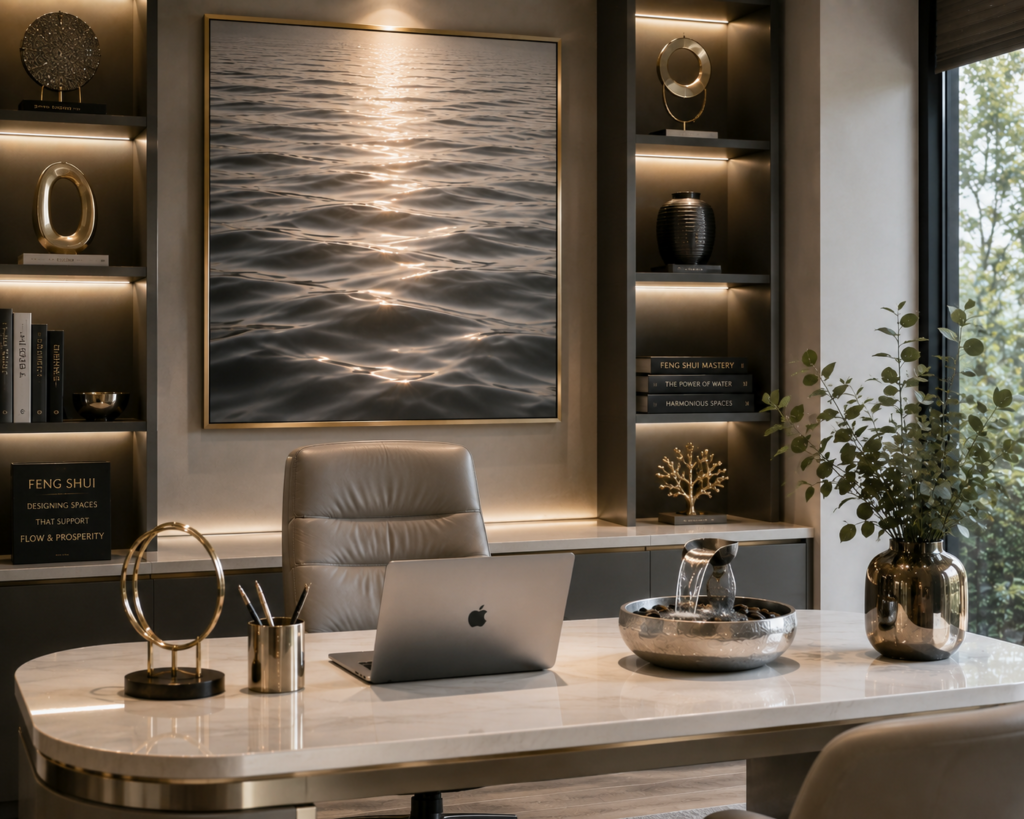
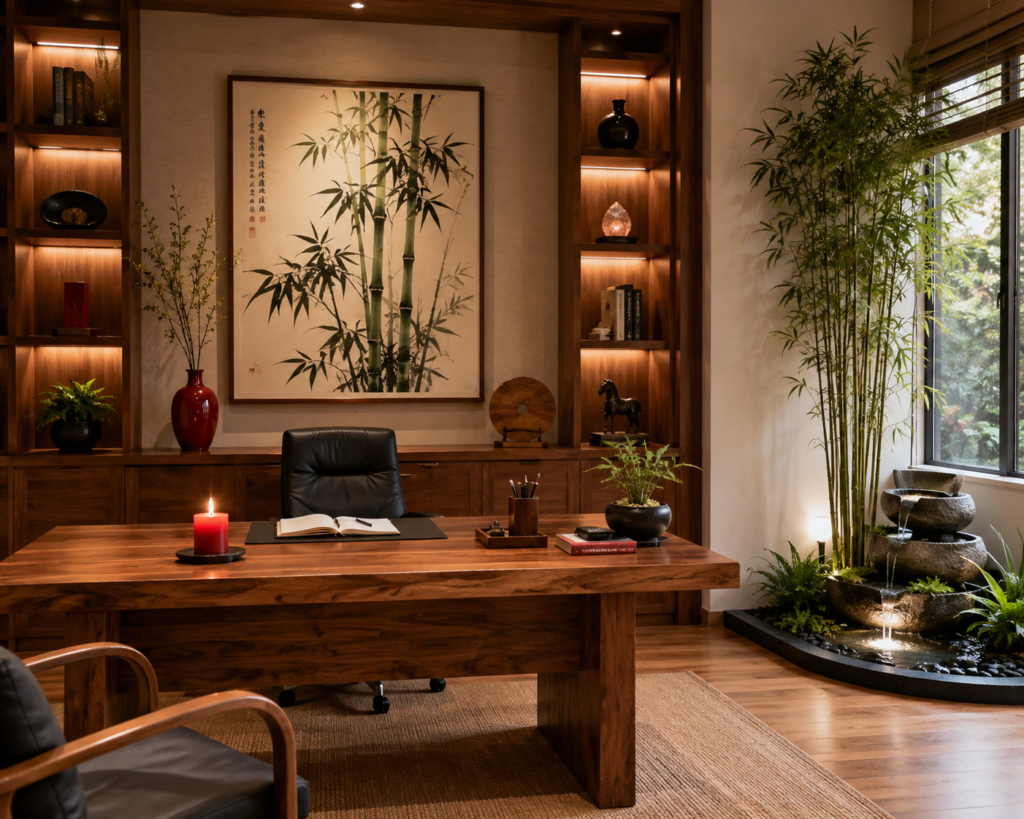
These office designs have been intentionally created around the permanent natal Flying Star active within each space.
Every colour, shape and material has been carefully selected to strengthen prosperous Qi, amplifying wealth, success, promotion, strategic thinking and new opportunities. Where a challenging Flying Star is present, the design strategy shifts to intentionally weaken its influence.
This is the power of Classical Feng Shui—designing with your office’s permanent energy instead of against it.
2. Feng Shui Office Decor That Sharpens Your Thinking
High performers don’t leave their environment to chance.
One of my favourite Feng Shui Office Decor ideas is placing one yellow object somewhere on your desk.
It could be your laptop, planner, notebook, coffee mug or pen holder.
Yellow has long been associated with learning, knowledge and mental clarity, making it a simple reminder to think strategically, stay curious and continue growing.
While I always choose colours that support the office’s permanent natal Flying Star, I nearly always keep something yellow within view.
Success is rarely built through one big decision. It’s built through small, intentional choices repeated every day.
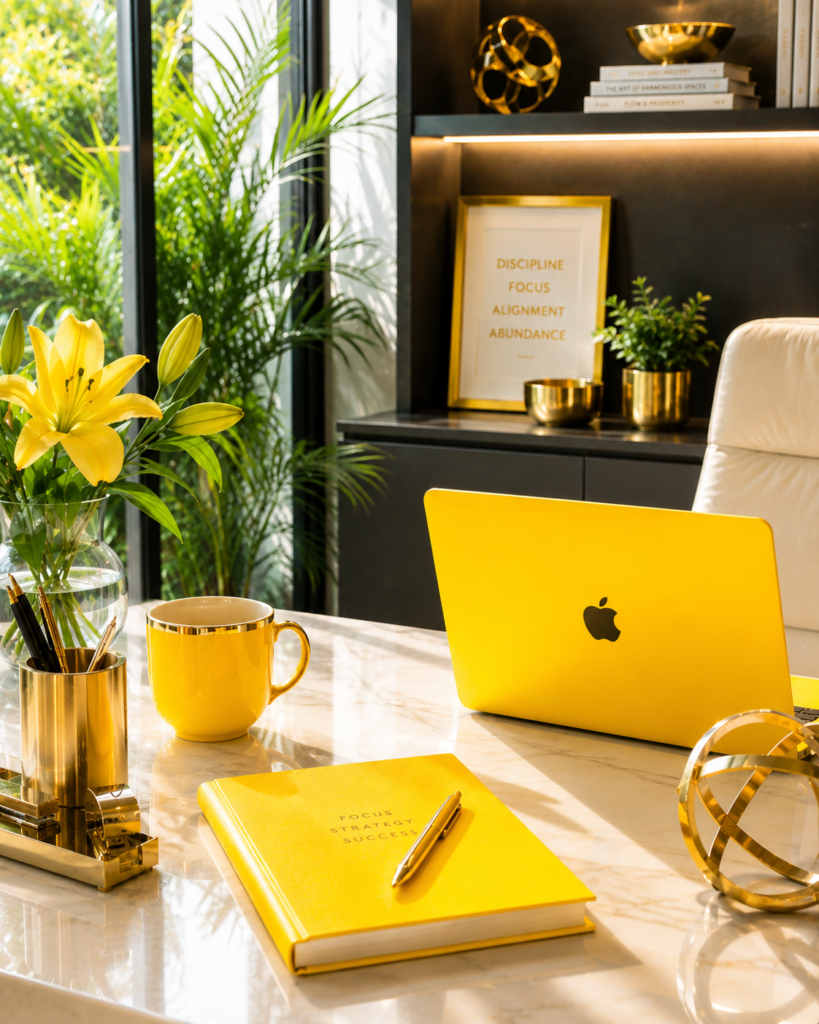
Notice how yellow has been incorporated through everyday objects rather than decorative accessories alone. The laptop, notebook, coffee mug and flowers each contribute to a workspace that feels uplifting while reinforcing learning, knowledge and focused thinking.
3. Your Office Decides What Deserves Your Attention
Before you choose your first task each morning, your office has already made hundreds of decisions for you.
It decides what your eyes are drawn towards.
What interrupts your concentration.
What reminds you of unfinished jobs.
What quietly encourages procrastination.
Most people believe they become distracted because they lack discipline.
Often, they’re simply working in an environment that constantly competes for their attention.
This is why I encourage every student to create a daily focus board as part of their Feng Shui Office Decor.
It doesn’t need to be large or complicated.
A simple planner, whiteboard, framed worksheet or even a notebook displayed on a stand can become one of the most valuable objects in your office.
The purpose isn’t to record everything you need to do.
It’s to remind you what deserves your attention today.
I recommend keeping only three things visible:
- Your single most important goal.
- The three tasks that move that goal forward.
- One sentence reminding you why that goal matters.
That’s it.
When your attention begins to wander—and it will—your eyes naturally return to the board.
Instead of asking,
“What should I work on now?”
your environment quietly answers the question for you.
This is one of the reasons I love Feng Shui.
People often think it’s about placing decorative objects around a room.
To me, it’s about designing environments that support better decisions.
Every object within your workspace is either pulling your attention away from your goals or gently guiding it back towards them.
Intentional people understand this.
They don’t simply manage their time.
They design environments that help them protect it.
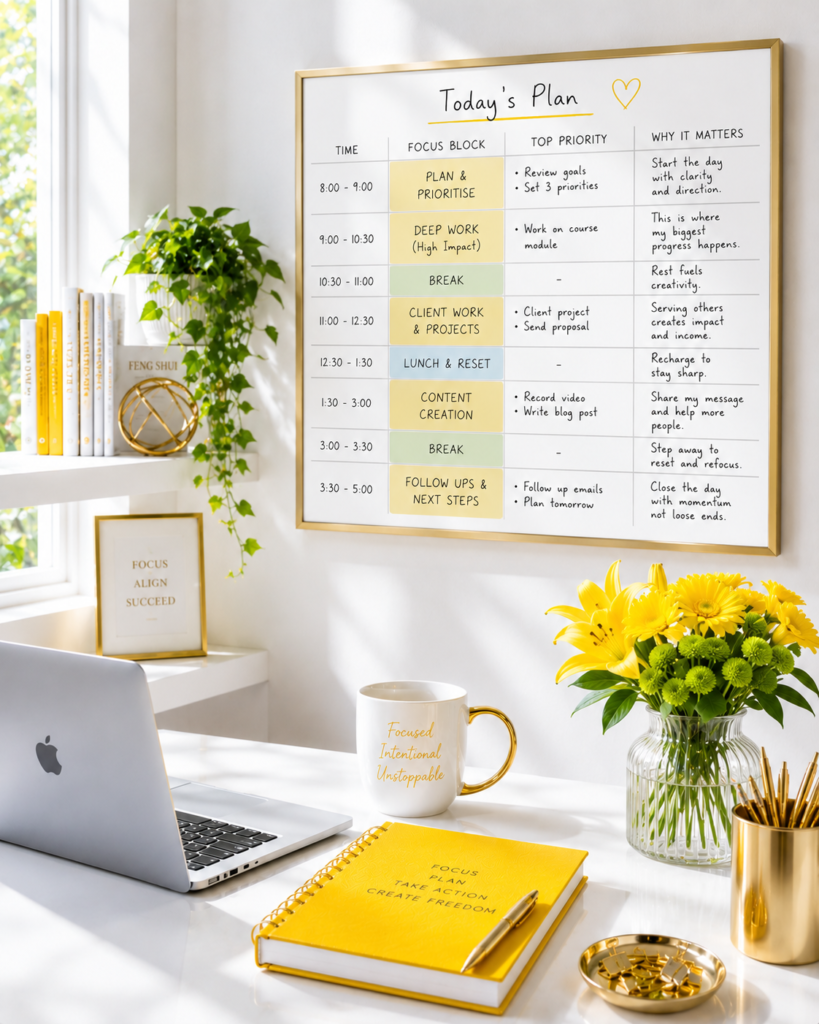
This planner has been intentionally displayed where it’s impossible to ignore. Rather than filling it with endless tasks, it focuses attention on what matters most. Every time you look up, your environment reminds you exactly where your time and energy should be invested.
4. Choose Artwork That Reminds You Why You Do What You Do
Every time you look up from your desk, your eyes land somewhere.
The question is…
What is that image teaching you?
Most people choose artwork because it matches the room.
Intentional people choose artwork because it matches the life they’re trying to create.
This is one of my favourite Feng Shui Office Decor principles because it’s about so much more than decorating a wall.
Whenever I choose artwork for an office, I first consider whether the colours, shapes and overall feeling support the permanent Flying Star and the compass sector of the room. Once I understand what is energetically appropriate, I look for something that also has personal meaning.
For me, that’s the Daintree Rainforest.
I love travelling, and it’s one of the places that has always spoken to something much deeper within me. My office is best supported by the Wood element, so rather than choosing a generic piece of green artwork, I chose a painting of the Daintree.
Every time I pause during the day and look up from my work, I’m reminded of a place that makes me feel grounded, inspired and connected to something much bigger than my to-do list.
That’s what meaningful artwork should do.
It shouldn’t simply fill an empty wall.
It should reconnect you with the reason you’re doing the work in the first place.
Perhaps it’s the coastline where you feel most at peace.
A mountain range you’ve always wanted to explore.
The city that inspires your ambition.
The vineyard where you celebrated something important.
Or a forest that reminds you to slow down and breathe.
Whatever it is, choose something that reflects a place, a memory or a dream that genuinely means something to you.
Because when your workspace reflects who you are—not just what looks fashionable—it becomes far more than an office.
It becomes a daily reminder of the life you’re intentionally creating.
And to me, that’s what great Feng Shui has always been about.
Not filling a room with lucky objects.
But creating an environment that quietly brings you back to yourself.
5. Feng Shui Office Decor Isn’t Always a Decorative Item
When people hear the words Feng Shui Office Decor, they often think about artwork, plants or decorative accessories.
Yet one of the most supportive additions to my workspace spends most of its time tucked away in a drawer.
A pair of comfortable headphones.
Whenever I need to write, study or think deeply, I’ll often put on binaural beats. Many people enjoy listening to them because they find they help create a calmer, more focused environment for deep work.
For me, they do something equally important.
They create a clear transition.
The moment I put my headphones on, my mind recognises it’s time to stop reacting to the outside world and give my full attention to the work in front of me.
That’s why I consider them part of my Feng Shui Office Decor.
A supportive workspace isn’t defined only by what you can see.
It’s also shaped by the environment you intentionally create around yourself.
Ask yourself:
What helps you do your best thinking?
Perhaps it’s binaural beats.
Perhaps it’s complete silence.
Whatever helps you settle into focused work, make it part of your workspace. Don’t wait until your concentration disappears before looking for it.
Prepare your environment first.
One of the greatest lessons Feng Shui has taught me is that meaningful change rarely comes from one dramatic improvement.
It comes from thoughtfully designing an environment that quietly supports the person you want to become, one intentional choice at a time.
6. What Is Pointing Towards You While You Work?
You’ve probably spent hundreds, perhaps even thousands, of hours sitting at your desk.
Yet there’s one question very few people ever think to ask.
What is pointing directly at me while I work?
Don’t answer straight away.
Sit exactly where you normally work.
Now look around the room without moving your chair.
Is the corner of a bookshelf directed towards you?
The edge of a cabinet?
The corner of another desk?
An exposed beam overhead?
The sharp edge of a wall?
In Form School Feng Shui, these are known as Sha Qi. They are sharp or aggressive forms that direct sharp energy towards the place where you’re spending your time.
They’re not something to fear.
They’re simply something worth noticing.
One of the first things I teach my students is that great Feng Shui begins with observation.
Once you notice something, you have the opportunity to improve it.
Sometimes the solution is as simple as moving your chair a little to one side.
Sometimes a rounded plant, a floor lamp or another piece of furniture is enough to soften that direct line.
Small changes can alter the way a workspace is experienced.
That’s why I encourage people to stop asking,
“What should I buy?”
and start asking,
“What am I experiencing while I sit here every day?”
Because your office isn’t simply the place where your work happens.
It’s the environment that’s quietly supporting—or competing with—your ability to do your best work.
The first step towards creating a more supportive workspace isn’t buying something new.
It’s learning to notice what has been there all along.


The image on the left demonstrates a sharp corner creating a poison arrow, directing Sha Qi into the room. The image on the right shows how the same feature can be softened using carefully placed décor that complements the overall design while reducing its energetic impact.
This is one example of how Feng Shui Office Decor can transform an ordinary design feature into one that is both beautiful and energetically supportive.
7. Beautiful Storage Is More Than Feng Shui Office Decor
Open storage displays everything you’ve decided to keep in your field of vision.
Look around your desk for a moment.
Not as someone tidying their office.
As someone deciding what deserves their attention.
Every stack of paper.
Every loose cable.
Every notebook.
Every collection of stationery.
Every unopened folder.
Each one is quietly asking your mind for something.
Individually, they seem insignificant.
Collectively, they become the environment your brain works within every day.
This is why I believe beautiful storage is one of the most underrated forms of Feng Shui Office Decor.
A timber desk organiser.
A woven basket.
A ceramic tray.
Decorative storage boxes.
A document holder.
Cable organisers.
These aren’t simply places to hide clutter.
They’re a way of deciding what deserves to remain visible and what no longer needs to compete for your attention.
One of the questions I regularly ask myself is:
“If this object disappeared from my desk today, would it make it harder to do my best work?”
If the answer is no, it probably doesn’t need to be sitting in front of me.
That doesn’t mean creating an empty office.
It means creating an intentional one.
An intentional workspace doesn’t remove personality.
It removes unnecessary competition for your attention.
Because every visible object is either helping you focus…
or quietly inviting you to think about something else.
To me, that’s what thoughtful Feng Shui Office Decor is really about.
Not filling a room with beautiful things.
But ensuring every beautiful thing has earned its place.
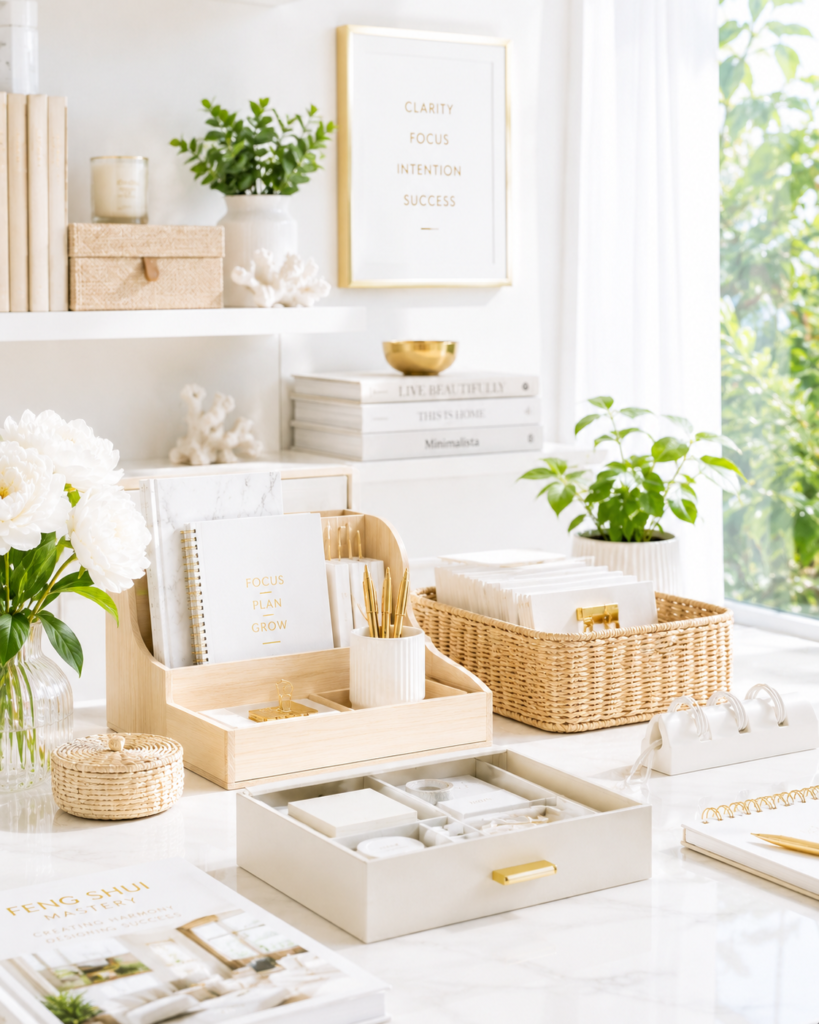
Every organiser in this workspace has a purpose. Frequently used items remain accessible, while paperwork, stationery and everyday essentials are stored neatly out of sight. The result is a workspace that feels calm, organised and free from unnecessary visual distractions.
8. A Healthy Plant Is a Daily Reminder That Growth Needs Care
Every business owner wants growth.
Every professional wants to keep learning.
Every goal asks something of us before it gives something back.
That’s one of the reasons I love including healthy plants as part of Feng Shui Office Decor.
Not because a plant magically creates success.
Because it quietly reminds us how success is created.
A thriving plant doesn’t happen by accident.
It needs the right environment.
Light.
Water.
Nourishment.
Time.
Remove one of those, and eventually the plant begins to struggle.
The same is true of us.
Our focus needs protecting.
Our knowledge needs developing.
Our businesses need consistent attention.
Our goals need regular action.
That’s why I encourage students to choose a healthy plant they’ll genuinely enjoy caring for, rather than buying one simply because someone said it’s “good Feng Shui.”
Ideally, I also consider whether introducing the Wood element is supportive for the permanent Flying Star influencing the office. Once I know the room can benefit from Wood, I choose a plant that complements both the space and the person working within it.
Then I ask one final question.
“If I can commit to caring for this plant every week, am I showing the same commitment to the goals I’m trying to grow?”
To me, that’s the real lesson.
Every healthy plant becomes a quiet reminder that growth is never created in one extraordinary moment.
It’s created through small, consistent actions repeated over time.
And perhaps that’s why healthy plants have remained such a meaningful part of Feng Shui for centuries.
Not because they promise success.
But because they remind us what success has always required.
9. Great Feng Shui Office Decor Invites You to Begin
Have you ever walked into a room and immediately felt like you didn’t want to stay?
Nothing was technically wrong.
Yet something about the space felt cold, dull or uninspiring.
Lighting often has far more influence than we realise.
One of the simplest ways to improve Feng Shui Office Decor is to create a workspace that feels inviting the moment you walk into it.
Not brighter.
More inviting.
Natural light is always a wonderful place to begin, but when that’s limited, thoughtful task lighting can completely change the experience of sitting at your desk. A well-positioned desk lamp doesn’t just illuminate your workspace—it creates a destination. It naturally draws your attention to the place where meaningful work happens.
I often encourage students to ask themselves one simple question:
“Does my office invite me to sit down and begin?”
Or…
“Does it quietly encourage me to walk away?”
It’s a subtle difference, but it’s an important one.
The easier your environment makes it to begin, the less energy you spend convincing yourself to start.
That’s why lighting deserves far more attention than it usually receives.
It isn’t simply there to help you see your work.
It helps shape the way you experience your work.
Thoughtful Feng Shui Office Decor should always reduce friction.
It should remove the small barriers that make beginning feel difficult and replace them with an environment that naturally draws you in.
Because success rarely depends on one extraordinary day.
It depends on creating a workspace you’ll happily return to, day after day.
10. Feng Shui Office Decor Should Create Sheng Qi
Have you ever walked into a space and immediately felt good?
You couldn’t quite explain why.
Nothing demanded your attention.
Nothing felt out of place.
The room simply felt welcoming.
Alive.
Comfortable.
That feeling is what Feng Shui describes as Sheng Qi.
It isn’t created by one beautiful lamp.
One healthy plant.
One piece of artwork.
Or one carefully chosen chair.
Sheng Qi is created when every decorative choice contributes to the same experience.
It’s the warmth of natural timber.
The softness of quality fabrics.
The life brought by healthy plants.
Artwork that means something to you.
Beautiful ceramics.
Thoughtfully chosen books.
Fresh flowers.
Good lighting.
Each object may seem insignificant on its own.
Together, they create something much greater than the sum of their parts.
This is where Feng Shui Office Decor becomes very different from simply decorating a room.
Decoration asks,
“What will look good here?”
Feng Shui asks,
“How do I want this room to feel every time I walk into it?”
That’s a very different question.
Because every decorative decision either contributes to Sheng Qi…
or it doesn’t.
As you look around your office today, ask yourself one final question.
“Which objects help this room feel alive?”
If an object contributes warmth, beauty, inspiration or a genuine sense of enjoyment, it has earned its place.
If it doesn’t…
Perhaps your office is quietly asking for something better.
Because Sheng Qi isn’t something you buy.
It’s something you intentionally create.
One thoughtful decision at a time.
Decorating Changes a Room. Education Changes the Person Designing It.
If you’ve made it this far, you’ve probably realised something.
Feng Shui Office Decor has very little to do with decorating.
It’s about learning to see your environment differently.
Perhaps you’ve already started looking around your own office.
Questioning the artwork on your walls.
Noticing what’s pointing towards your desk.
Thinking differently about colour, lighting, plants and the objects you’ve chosen to surround yourself with.
That’s exactly how learning begins.
Not by memorising rules.
By seeing something you’ve looked at every day from an entirely new perspective.
This article has only scratched the surface.
Behind every colour, every material, every decorative choice and every Feng Shui recommendation is a principle that explains why it belongs there.
Once you understand those principles, something remarkable happens.
You stop copying Feng Shui.
You start understanding it.
You stop searching for decorating tips.
You begin making confident decisions because you understand the reasoning behind them.
To me, that’s what education should do.
It shouldn’t give you more answers to memorise.
It should change the way you think.
That’s why I created Feng Shui Mastery.
I didn’t create it to give people another collection of rules or decorating ideas.
I created it to teach the principles of traditional Feng Shui in a way that allows you to confidently assess a property for yourself, understand its unique energetic blueprint and make informed design decisions with clarity and purpose.
Because anyone can copy a beautiful room.
A Feng Shui practitioner understands why it works.
If you’re ready to stop collecting Feng Shui tips and start thinking like a Feng Shui practitioner, I’d love to welcome you into Feng Shui Mastery.
Your home has a story to tell.
It’s time to learn how to read it.